
What to Expect From an Emface Facial Treatment
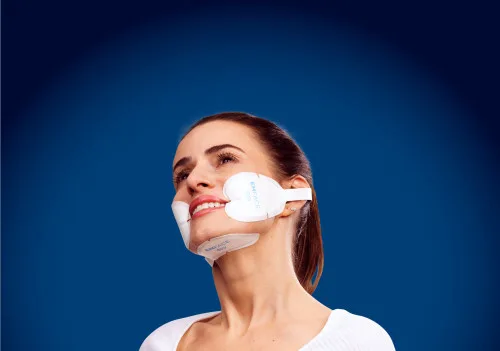
BTL, the company that makes Emface, says that during a session you feel gentle muscle contractions combined with a warming sensation. It describes its standard protocol as four 20-minute sessions, typically spaced one week apart, and adds that a provider may recommend a customized plan (BTL Industries).
Before a first session, it helps to be clear about which area you have in mind and what you hope will change, and to go in ready to ask about the plan, the evidence behind it, what change you might expect, any recovery and whether the treatment suits you. Below, we cover how the manufacturer describes the treatment, a related FDA record, the safety information, and the questions worth taking to a consultation.
Considering Emface? Call us at 862-247-8030.
What Emface is
BTL says Emface combines synchronized radiofrequency with HIFES muscle stimulation. For the face, BTL describes the radiofrequency as stimulating collagen and elastin production and the HIFES stimulation as inducing muscle activity that supports facial structure (BTL Industries).
That is how the manufacturer says the device is designed to work. It is not a measurement of what will change for you.
Which areas it is made for
BTL lists Emface applicators for the forehead, cheeks, eyes, submentum (the area under the chin) and jaw, and describes its aesthetic treatment as targeting the jawline, double chin, eyes and the overall look of the skin (BTL Industries).
Those are the applicators BTL describes. Ask us which areas and applicators we offer when we discuss your goals.
What a session involves
The sensation and the four-session pattern described above are the manufacturer’s standard description, not a plan made for you. We can discuss what we would recommend for you and why.
What the manufacturer says it is cleared for
BTL states that Emface is cleared for noninvasive temporary reduction of facial wrinkles. It also states that its Submentum and Eye applicators are FDA-cleared for aesthetic use including facial and neck stimulation or body skin stimulation, and that the Submentum applicator is further cleared to affect the appearance of lax tissue in the submental area (BTL Industries).
Those are BTL’s own statements about clearance, and a statement about clearance is not a statement about results. If they matter to your decision, ask which clearance covers the device and applicator you would be treated with.
What one FDA record shows
FDA’s 510(k) database lists K242532, a device called BTL-785BNF-E from BTL Industries, classified as a transcutaneous electrical stimulator for aesthetic purposes, with a decision of “Substantially Equivalent” dated December 13, 2024 (U.S. Food and Drug Administration).
It is indicated for aesthetic use including facial and neck or body skin stimulation, and marked for prescription use. Its 510(k) summary says the device was shown substantially equivalent to a cleared predicate device based on the intended use, a comparison of technical characteristics and performance testing, and that a clinical study was not conducted for this submission (U.S. Food and Drug Administration).
BTL’s wording for the clearance of its Submentum and Eye applicators (BTL Industries) is close to, but not the same as, the indication in this FDA 510(k) clearance for a BTL device, BTL-785BNF-E (K242532) (U.S. Food and Drug Administration). BTL’s page does not name that FDA device (BTL Industries), and the FDA record does not name Emface (U.S. Food and Drug Administration).
So the two documents do not show that they describe the same clearance.
Safety information to raise beforehand
BTL’s safety information says results may vary. During treatment you may feel heat, but you should never feel an unpleasant burning or pain sensation. Treatment should not be applied over hair or scar tissue, or if you have electronic or metal implants, and side effects may include temporary damage to the skin: crust, blister and burn (BTL Industries).
BTL also says that, as with any medical procedure, you should ask your doctor whether the procedure is right for you (BTL Industries).
That information is not a complete list of who should or should not have treatment. Tell us about any implants, scars, skin conditions and other health concerns at your consultation. We can also discuss what, if anything, you should do afterward.
If your concern is jaw pain
Pain in the mouth, jaw or face may or may not be related to a temporomandibular disorder (TMD) (National Institute of Dental and Craniofacial Research). That is a separate question from appearance, and our article on Emface for TMJ: what to ask before treatment covers it.
Questions to ask before treatment
- Which applicators and treatment areas do you offer?
- What evidence supports this treatment for the area I am interested in, and can you point me to it?
- What change, if any, might I expect, how soon, and how long might it last?
- How many sessions would you suggest for me, and why?
- What might I feel during and after a session, and is there any recovery time, bruising or skin reaction to plan for?
- Is it suitable for me, given my health, any implants or scars and my skin, and what other options should I weigh?
- What should I report to you during a session?
- Is there anything I should do or avoid afterward?
- How will we judge whether it is working for me?
Talk to us about Emface
We offer Emface at our office. If you are thinking about Emface for your face, call us at 862-247-8030 or book a consultation, and bring the questions above with you. You can also read more on our Emface page.
Sources
- BTL Industries. “Emface.” https://bodybybtl.com/solutions/emface
- U.S. Food and Drug Administration. “510(k) Premarket Notification K242532.” https://www.accessdata.fda.gov/scripts/cdrh/cfdocs/cfpmn/pmn.cfm?ID=K242532
- U.S. Food and Drug Administration. “K242532: FDA substantial equivalence letter, Indications for Use and 510(k) Summary (BTL-785BNF-E).” Published 2024-12-13. https://www.accessdata.fda.gov/cdrh_docs/pdf24/K242532.pdf
- National Institute of Dental and Craniofacial Research. “TMD (Temporomandibular Disorders).” https://www.nidcr.nih.gov/health-info/tmd